
MASTER'S IN WOOD ARCHITECTURE AND CONSTRUCTION
Duration
1 year
Admission
M1 in Civil Engineering, Architecture
Internship
4 to 6 months
Status
Full-time, Apprentice
“Building with wood” is the clearly stated objective of the “Wood Construction Architecture” pathway of the Master’s in “Civil Engineering” at the University of Lorraine, co-accredited with the National School of Architecture of Nancy.
WHY?
Primarily reserved for engineers, architecture graduates, and students (from university or engineering schools) who have completed an M1 or M2 in Civil Engineering, this Master’s pathway supports the development of wood in construction and the initiatives implemented at the national level to promote this sector.
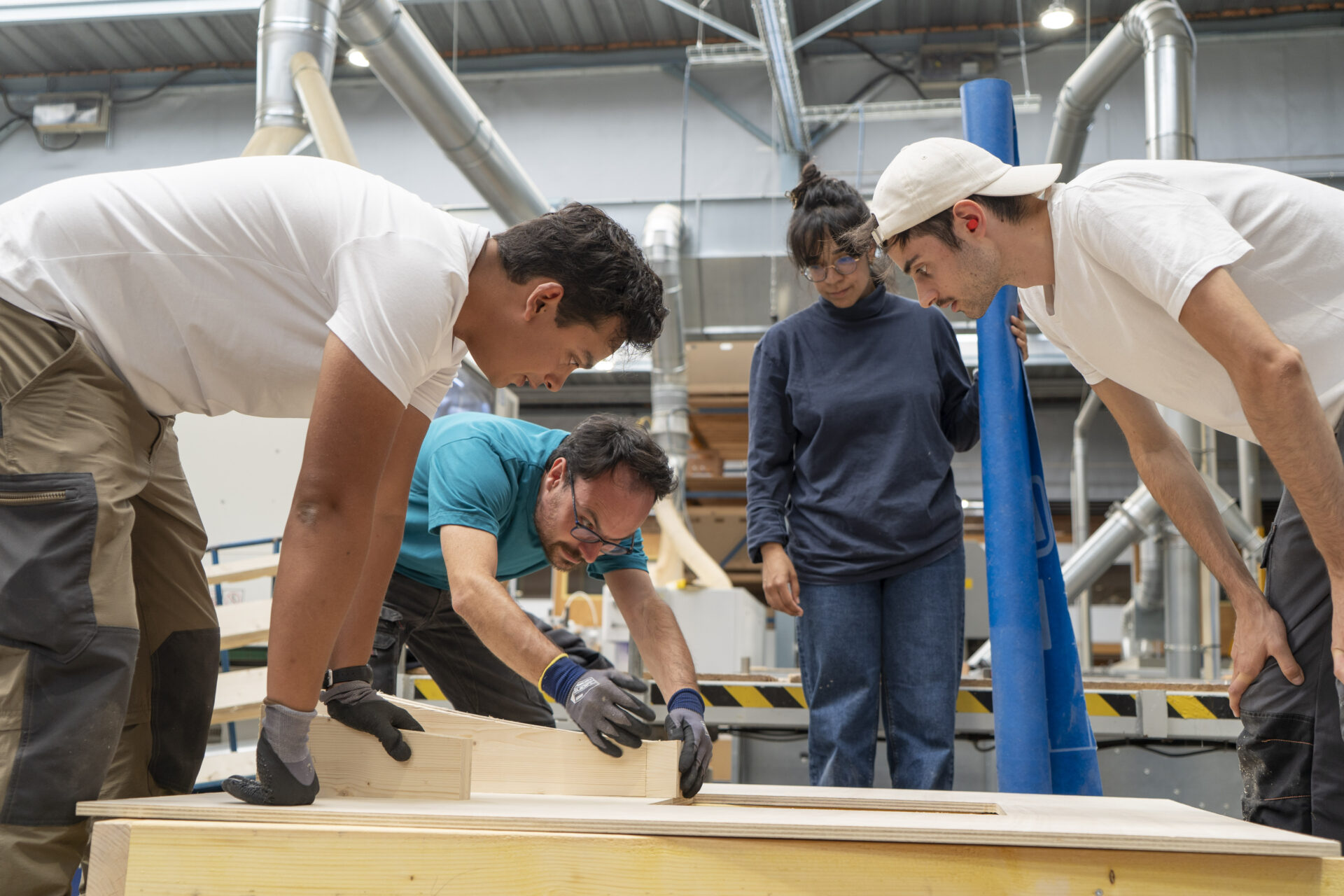
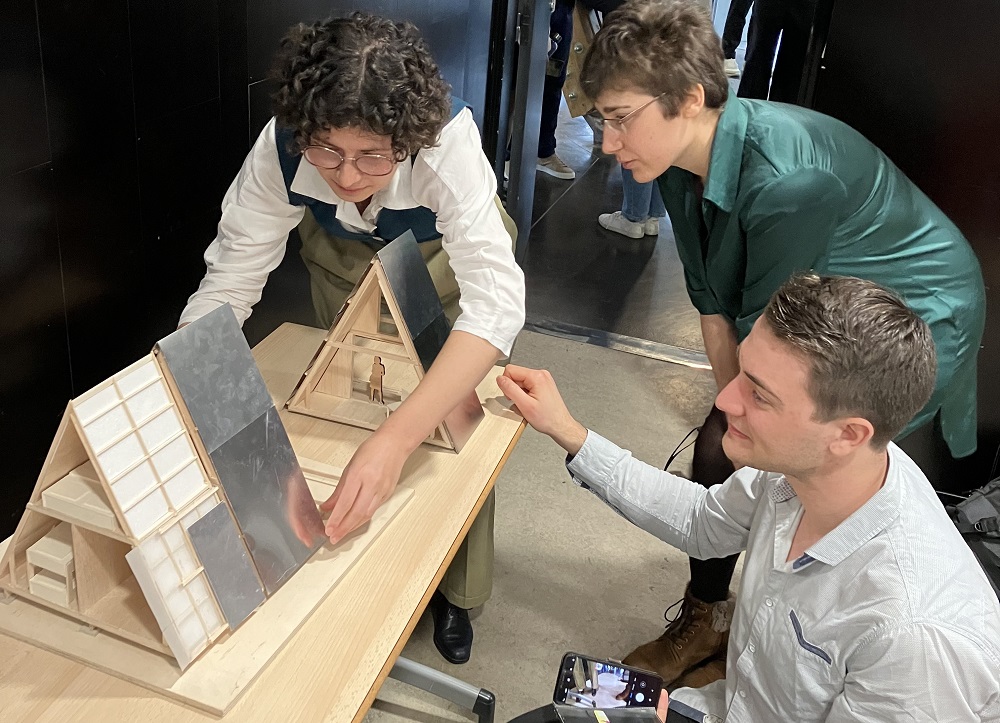
This Master’s pathway enables architects and engineers to acquire dual expertise through an original training programme focused on the techniques of using wood in building construction. It equips architects with the essential technical knowledge to successfully undertake a wood construction project and allows engineers to understand the various characteristics of the material during a project. It also aims to enhance collaboration between engineers and architects to optimise the design and cost-efficiency of projects, ultimately leading to improved quality.
FOR WHOM?
Selection based on application and individual interview for:
- M1 in Civil Engineering – Constructions, Materials, Wood pathway
- Other M1 programmes (Civil Engineering, Engineering students, etc.)
- Architecture Gradiates (DPLG, DEA, DESA, INSA)
- Civil Engineering Graduates
- Professionals in continuing education with recognition of prior learning (minimum of 3 years of professional experience)
- Non-European Union students holding a degree in Architecture or Civil Engineering
After applications are examined, interviews are held in June.
The number of places is limited to 30, including a maximum of 4 places for apprenticeship training with the CFA BTP in Pont- à-Mousson.
PROGRAMME
|
MATERIALS, CHARACTERISTICS AND CONTEXT |
|
WOOD TECHNOLOGIES |
|
BUILDINGS AND STRUCTURES TECHNOLOGIES |
|
HOME COMFORT |
|
|
WOOD ARCHITECTURE AND RESEARCH |
|
|
PROJECT REQUIREMENTS |
|
|
ENGLISH | |
|
INTERNSHIP |
|
|
PROJECT AND IMPLEMENTATION |
TEACHING
TESTIMONIALS
The ABC Master’s programme was a very enriching experience in terms of project work. I learned to work in a team with architects, and also, during the Wood Challenges, with skilled craftsmen. Collaborating with people from different educational backgrounds brought me a lot. I participated in the design of stations for URBANLOOP, and our team’s project was chosen by the jury. It’s very interesting to work with the vision of architects, who know how to meet a client’s requirements, especially through aesthetics. This programme proved to me that I am capable of overseeing a project both over time and while respecting technical constraints, organisation, and aesthetic choices. Today, I am a site manager, but thanks to the ABC Master’s programme, I know that I can adapt and have a different perspective on a project. At ENSTIB, I received training aligned with my professional projects, but more importantly, I was able to learn in very good conditions, in a family-like atmosphere, with competent and caring professors. I had the chance to do several internships at the company where I currently work, and although I am from the South of France, I have chosen to stay in the Grand Est for now, and I feel good here.
When I pursued the dual degree of the ABC Master’s programme, the project we worked on was the design of the ENSTIB Coloc, a building funded by the school’s alumni and intended to house future students. I learned to work on blueprints and significantly improved my spatial perception. Generally speaking, this programme gave me a better understanding of an architect’s reasoning, which is a real asset in my profession. I recently worked for three years on the renovation of the Administrative City of Bourges, consisting of buildings from the 17th, 19th, and 20th centuries. What I learned during the Master’s programme was very useful in my interactions with the architect who accompanied the project. I have excellent memories of ENSTIB, the life at the School, and the surrounding area. The Wood Challenges were an unforgettable experience, both from a human and educational perspective. Designer, calculator, and implementer – we had to play all roles and adapt. This programme opened my eyes to integrating wood and bio-sourced materials into the projects I manage, but it also taught me a way of working, thanks to an exceptional approach to teaching, with no real boundary between teachers and students. I learned a lot and I’ve also maintained some excellent relationships with both the School staff and my fellow classmates.
Admissions
Should you require any further information, feel free to contact us at
enstib-international@univ-lorraine.fr